API vs web scraping — which is best for collecting website data?
Compare APIs and web scraping by reliability, cost and data coverage, then choose the right integration method for your business.
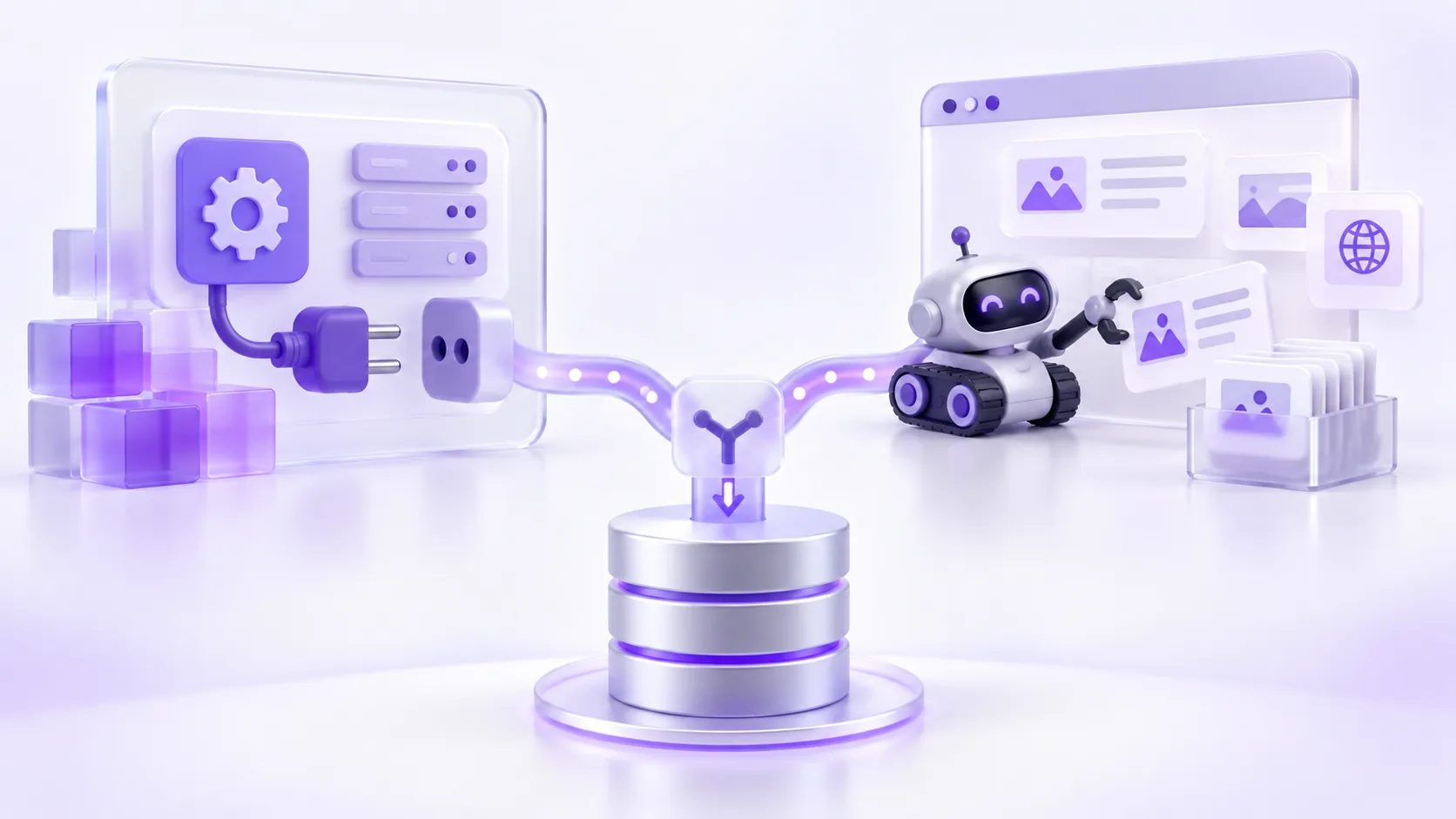
A company publishes information on its website, but you need that data in Excel, an ERP system or your own application. Should you connect to an API or read the website with web scraping? Both methods can produce a similar result, but they differ in reliability, data coverage, implementation cost and access rules.
The short answer is: if the data owner provides a suitable, well-documented API, it is usually the best place to start. Web scraping is useful when no API exists, the API omits important information, or you need to compare data exactly as it appears to a website visitor.
In practice, you do not always have to choose one method. A robust integration may retrieve a product catalogue from an API while reading the public website only for a promotional price or delivery estimate.
What is the difference between an API and web scraping?
An API, or application programming interface, is a data exchange mechanism created by the system owner. An application sends a request to a defined endpoint and receives a structured response, usually in JSON or XML. Documentation describes the available fields, authentication, limits and possible errors.
Web scraping automatically reads information from an HTML document or a page rendered in a browser. The system locates relevant elements, transforms them into a shared format and saves them at the destination. It works with an interface designed for a person rather than a data source designed for another application.
| Criterion | API | Web scraping |
|---|---|---|
| Data structure | Usually structured and documented | Must be identified in the page code or rendered view |
| Reliability | Usually higher, especially with versioning | Depends on changes to layout and website behaviour |
| Data coverage | Limited to fields exposed by the provider | Information visible on the public website |
| Access | API key, token, account or open endpoint | Public page, sometimes a browser and session |
| Limits | Defined request or subscription limits | Safe request frequency must be established |
| Maintenance cost | Usually lower for a mature API | Higher when the website changes frequently |
These are typical differences, not an automatic verdict. An undocumented, unstable API can be harder to maintain than a simple public HTML table whose structure has remained unchanged for years.
When is an API the best choice?
You need to exchange many records regularly
APIs work well for synchronising catalogues, orders, customers, documents and inventory. The response has predictable fields and excludes components used only to display the website. There is no need to run a browser or interpret an entire user interface.
The integration must write as well as read data
Scraping is primarily a read operation. If the system must create an order, change a status, add a contact to a CRM or send a document, the official API is the appropriate route. It supports controlled permissions and usually returns an unambiguous success or error response.
Predictable change management matters
A good API has versions and documentation. The provider can announce the retirement of an older endpoint and allow time to migrate. A website redesign does not then affect the integration because the data layer is independent of the user interface.
You need data that is not visible on the website
An API may expose identifiers, precise stock levels, timestamps, technical statuses or change history that the public website does not display. These fields make it easier to match records and avoid processing the same information more than once.
When does web scraping make more sense?
The service has no API
This is the most common reason. Many websites publish price lists, offers, listings or results without providing an interface for external applications. If the information is public and its use complies with applicable law and the website terms, a scraper can turn it into structured data.
The API does not contain the data you need
An interface may return the product name and base price, while the website also shows a promotion, local availability or estimated delivery date. From a business perspective, these additional fields may be the most valuable ones.
You need to verify what a customer actually sees
Competitor monitoring often depends on the final offer displayed to the shopper rather than a value stored in the shop's internal system. The price may depend on the variant, active promotion, pack size, unit or location. Reading the website makes it possible to check the result after those rules have been applied.
The sources are simple and rarely change
A public table, catalogue or listing may be easy to collect without full browser automation. If the layout is stable and the scope is modest, a well-designed scraper can be both simple and economical.
When is neither method ideal?
Not every technically accessible source is worth integrating. A problem arises when the API is closed or prohibitively expensive while the website requires authentication, aggressively blocks automation or changes frequently. In that case, assess alternatives such as:
- a scheduled CSV or XML feed from the supplier,
- an export delivered by email or FTP,
- a webhook that reports changes only,
- a ready-made platform connector,
- direct integration with the source database or system,
- a partly manual process for a small number of exceptions.
The best solution is not the most advanced technology. It is the simplest reliable source that provides the required data on acceptable terms.
A hybrid solution: API and scraping in one workflow
Combining the methods makes sense when each source supplies a different part of the information. A product monitoring system might:
- retrieve identifiers, names and variants from an API,
- read the current retail price and availability message from the website,
- join records by EAN, SKU or product identifier,
- store history in one database,
- send an alert only when a change exceeds an agreed threshold.
The API provides a stable data backbone while scraping fills in fields that depend on the public view. The design must state which source is authoritative for each field. Without this rule, the system may overwrite correct values or report differences that are not meaningful.
What affects implementation and maintenance cost?
Retrieving one API response or one web page is only a small part of a production project. Cost depends mainly on source quality and the rules applied after collection.
For an API, effort increases with incomplete documentation, unusual authentication, strict limits, pagination, multiple endpoint versions and write operations. Scraping adds selector changes, JavaScript-rendered content, page variants, blocking and the possible need to run a browser.
Both approaches should account for:
- validation of required fields,
- mapping units, categories and identifiers,
- duplicate removal,
- retries and limit handling,
- logs and missing-data alerts,
- tests on a representative sample,
- monitoring after launch.
A cheap prototype without these safeguards may work during a demonstration but fail to support daily unattended operation.
How to choose a method step by step
1. Define the outcome, not the technology
List the required fields, record count, update frequency and destination. Five prices collected weekly require a different solution from one hundred thousand inventory records updated every hour.
2. Check every official source
Look for API documentation, exports, product feeds and ready-made integrations. Ask the data owner as well: an interface may exist even if it is not publicly documented.
3. Compare a sample with your requirements
It is not enough to confirm that an API responds. Check whether it contains the correct variants, current values and stable identifiers. A scraper should likewise be tested across different page types, missing values and unusual records.
4. Review access rules and risk
Assess the API terms, website terms, type of data and reasonable request frequency. For more context, read our guide to whether web scraping is legal in Poland and the EU.
5. Plan for failures and changes
Decide what should happen when a source is unavailable, returns fewer records than usual or changes its format. A safe process stops a suspicious update and sends an alert instead of storing incorrect data.
API vs web scraping — summary
Choose an API when it provides the necessary data, has clear access rules and will support regular system integration. Choose web scraping when data exists only on a public website or the exact customer-facing view matters. Combine both methods when the API supplies stable identifiers and the website provides important additional details.
If you are still assessing a particular source, see our guide to extracting website data into Excel or an application.
Want to assess a specific data source?
Send us the website address, API documentation or a sample export and describe the fields you need. As part of our systems and data integration service, we can compare the available methods, run a sample extraction and design a workflow with validation and monitoring.
Describe the source and expected result in our contact form. An address, field list, approximate record count and required update frequency are enough for an initial assessment.